


Techniques
Bowls and Tableware
Porcelain
Katherine likes to work with porcelain, a fine white high-firing clay, developed by the Chinese for its beauty and strength. Although harder to work with than coarser clays, its superior properties (translucent appearance and reactivity with glazes) make the effort worthwhile.
Throwing and Rolling
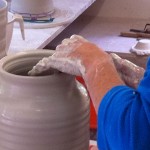 The porcelain Katherine uses is mostly dug from sites in New South Wales and Victoria. Before hand-throwing her work on a wheel, she spiral wedges (kneeds) the clay, knocking out any bubbles and making it workable. She creates some pieces from slabs of clay – “rather like rolled out pastry”.
After throwing or handbuilding, Katherine leaves her work to dry to a leather-hard state before she “turns” it – trimming, refining and finishing it with additions – e.g. handles. She then lets it dry thoroughly before Bisque firing it to 1000 degrees – making it strong enough to hold its shape, yet porous enough to hold the glaze.
Glazing
Katherine makes all her own glazes, describing the process as not unlike breadmaking.
Glazes are made up from powdered natural materials, such as feldspars and kaolin, coloured with oxides of elements such as cobalt, red iron and manganese. Tiny percentages of oxides are mixed with the base to create glazes that melt when fired and create many different colours.
Katherine creates a “soft pretty blue”, for example, by mixing less than 2% of cobalt with the natural base. Or she might use titanium dioxide to opacify the glaze and encourage colour response.
Depending on the ways in which glazes are applied and treated (thickness, order of layering, temperature and duration of firing), they give very different results. A black or gray glaze containing titanium, for example, can give the appearance of optical blue (a blue that contains no blue colourant) when layered over a white glaze.
Katherine experiments with alchemies of colour and effect by melding the properties of porcelain and glaze. Her work reflects artistic influences from East and West, but is essentially her own. Contemporary and unique.
Firing
After glazing, pots are fired again to 1260 degrees.
Durability and Care
Katherine uses strong clays and fires to high temperatures to make her pottery more durable than earthenware. You can put her pieces in the dishwasher, microwave and oven, but you should also take care to avoid thermal shock (placing a very hot item on a cold surface or vice versa). Very fine pieces should be treated accordingly.
Eggheads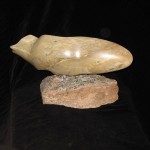
Abstract busts in different sizes, Katherine’s “eggheads” range from small pieces that fit in the palm of a hand to larger-than-life sculptures that make an interesting statement in a landscaped garden, courtyard or foyer. Eggheads can be arranged in ways that reflect the general ambience of their setting and describe different moods and feelings of their own.
Strong stoneware
Katherine sculpts her eggheads with strong stoneware clay and layers them with slips (liquid clay) made from earth gathered from a friend’s farm in the Blue Mountains west of Sydney. Using different coloured earth from different deposits, she adds layers until she achieves the right effect.
Sculptures
Katherine works largely in clay and soapstone, abstract in style. She took classes from well known Sydney sculptor, Helen Leete, and exhibits regularly in a variety of local exhibitions and venues.
Contact
Phone: 61 2 9449 9944